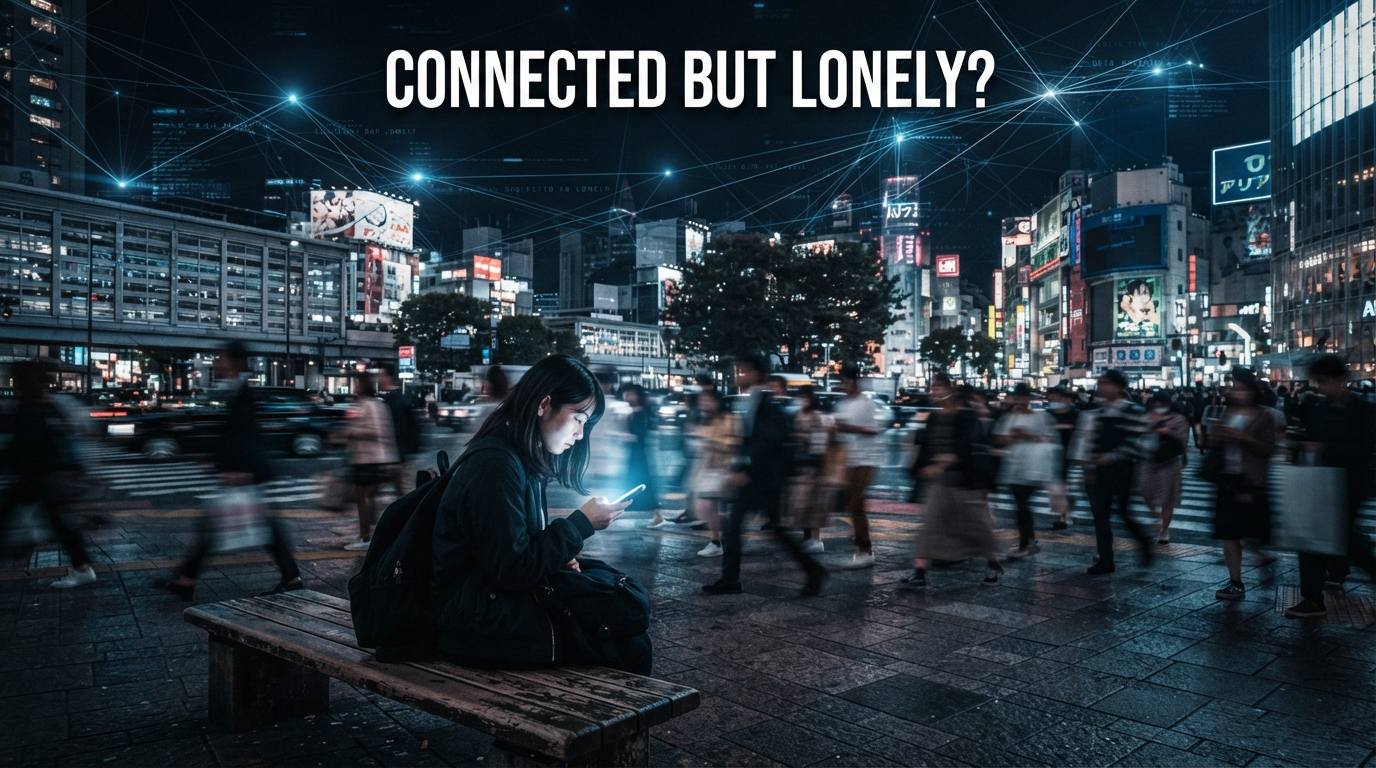
We can message someone on the other side of the planet in seconds.
We carry hundreds — sometimes thousands — of contacts in our phones. We see friends, celebrities, coworkers and strangers every day through Instagram, TikTok, WhatsApp, video calls and online communities.
Yet millions of people are going to bed feeling deeply alone.
According to the World Health Organization, roughly one in six people worldwide report experiencing loneliness. Among adolescents and younger people, the proportion is even higher.
That creates one of the defining contradictions of modern life: we have never had more ways to communicate, yet many people do not feel genuinely connected.

We are surrounded by digital communication, but communication and meaningful human connection are not always the same thing.
First: What Does Loneliness Actually Mean?
Loneliness and social isolation are related, but they are not the same thing.
The World Health Organization defines loneliness as a distressing subjective feeling that appears when there is a gap between the social connections a person has and the connections they want or need.
Social isolation, by contrast, is more objective. It describes having relatively few relationships, social roles or interactions.
| Situation | What It Means |
|---|---|
| Living alone but feeling fulfilled | A person may be physically alone without feeling lonely. |
| Being surrounded by people but feeling unseen | A person can have many contacts and still experience severe loneliness. |
| Having few regular social interactions | This may be considered social isolation. |
| Having relationships but lacking emotional closeness | This can produce loneliness even without physical isolation. |
How Can Someone With 1,000 Online Friends Still Feel Alone?
Imagine two people.
The first has 30 contacts but three people they can call when life becomes difficult.
The second has 3,000 followers, receives hundreds of likes, speaks with people all day — but has nobody they feel comfortable calling at midnight when something goes wrong.
Who is more socially connected?
The number of contacts is not necessarily the answer.
Meaningful connection is influenced by the quality of relationships, whether people feel supported, how often they interact, whether they can be vulnerable and whether the relationship feels mutual.
The Global Scale of Loneliness
The WHO Commission on Social Connection estimates that about 15.8% of people globally experience loneliness.
The burden is not identical everywhere.
Young people report particularly high levels. Around 21% of adolescents say they experience loneliness.
WHO data also indicate higher reported loneliness in lower-income countries — around 24.3%, compared with approximately 11% in high-income countries.
The figures show that loneliness is not simply a problem of retirement, old age or living alone.
It can affect teenagers, university students, workers, parents, migrants, business owners and people living in crowded cities.
Why Are Young People So Affected?
At first, this seems strange.
Younger generations have grown up with more communication technology than any generation before them.
But communication tools can solve one problem while creating another.
Constant Comparison
Social platforms expose people to carefully selected versions of other people's lives.
You may see the holiday, the engagement, the promotion, the new car, the restaurant and the party.
You usually do not see the anxiety before the photograph, the argument afterwards or the hours somebody spent alone.
Repeated comparison can create the impression that everyone else is living a fuller social life.
Friendships Can Become More Fragmented
A person may participate in dozens of group chats without having many deep conversations.
The interaction is real — but depth, attention and emotional presence may be limited.
Major Life Transitions
Adolescence and early adulthood include frequent changes: leaving school, starting university, moving, changing jobs, entering or ending relationships and establishing a new identity.
Transitions can weaken old social structures before new ones have fully formed.

Digital connection can be valuable, but it does not automatically provide the emotional depth people need.
Is Social Media Causing the Loneliness Crisis?
It would be too simple to say yes.
Social media can help people maintain relationships, find communities, communicate with relatives abroad and connect with people who share similar interests.
For someone who has moved to another country, lives with a disability or belongs to a small community, online communication can be extremely valuable.
But the WHO also identifies excessive or harmful use of digital media as one potential driver of loneliness and isolation, particularly among young people.
It is: “Is the way we use it strengthening our relationships — or replacing them?”
Scrolling Can Look Social Without Being Social
There is a major psychological difference between actively speaking with a close friend and passively scrolling through hundreds of posts.
One involves mutual interaction.
The other can involve watching other people interact.
Both happen on the same phone screen, but they may feel very different emotionally.
A Typical Modern Evening
7:15 PM — You reply to five WhatsApp messages.
7:40 PM — You watch Instagram Stories from friends.
8:20 PM — You scroll TikTok.
9:00 PM — You answer work messages.
10:30 PM — You check another group chat.
11:30 PM — You realize you have been interacting with people for four hours...
...but you have not had one meaningful conversation.
Big Cities Can Be Surprisingly Lonely
Loneliness is not limited to rural areas or physically isolated communities.
Someone can live in a tower with hundreds of apartments, work in an office with hundreds of employees and travel on crowded public transport every day — and still feel disconnected.
Modern cities can offer enormous numbers of human encounters without creating lasting relationships.
People move frequently. Neighbours may not know each other. Commutes consume time. Workdays can be long. Many interactions are transactional rather than personal.
Being surrounded by strangers is different from belonging to a community.
Migration Can Create a Special Kind of Loneliness
Millions of people live away from the place where they grew up.
Moving for work, education, safety or economic opportunity can improve life dramatically, but it can also remove the social network that once existed automatically.
Family gatherings become video calls. Childhood friends live in another time zone. Familiar neighbourhoods disappear.
A person may have a successful career and an active life while still missing the sense of belonging they once had.
Remote Work Changed the Social Side of Work
Working from home has brought major advantages to many workers: flexibility, less commuting and greater geographical freedom.
But work also used to provide something that rarely appeared on a job description: repeated casual social contact.
The conversation before a meeting, lunch with colleagues, a quick joke at someone's desk or simply seeing familiar faces provided a form of social structure.
Remote work can reduce some of those spontaneous interactions.
That does not mean remote work causes loneliness for everyone. Some people become happier and more socially active when commuting disappears.
The effect depends partly on what replaces workplace interaction.
Why Loneliness Is More Than an Unpleasant Feeling
For many years, loneliness was treated primarily as an emotional issue.
Health organizations now view social connection more broadly as an important part of health and well-being.
WHO says loneliness and social isolation are associated with physical and mental health problems including cardiovascular disease, type 2 diabetes, depression and anxiety.
The organization estimates that loneliness is associated with approximately 871,000 deaths globally each year.
How Could Relationships Possibly Affect Physical Health?
Human beings evolved as deeply social organisms.
For most of human history, survival depended heavily on belonging to a group.
Social disconnection can influence stress, sleep, behaviour, activity patterns and how people access practical or emotional support.
For example, someone with a strong social network may have people encouraging them to seek medical help, exercise, eat regularly or recover after illness.
Someone who feels disconnected may have fewer sources of help during difficult periods.
The Loneliness Cycle
One reason loneliness can be difficult to escape is that it can become self-reinforcing.
A person may begin declining invitations because they feel uncomfortable.
After declining several times, invitations arrive less frequently.
That can reinforce the belief that nobody wants them there.
The cycle can continue even when neither side intended to end the relationship.
Why Adult Friendships Become Harder
When people are children or students, repeated social contact happens naturally.
You see the same people every day.
Adults often lose that built-in repetition.
Careers become demanding. Partners and children require time. Friends move to different cities. Schedules stop matching.
Friendship increasingly requires planning.
Two people can care deeply about each other and still go months without seeing each other because nobody chose a date.
The “I'm Too Busy” Problem
One of the strange features of modern loneliness is that people often want more connection but allocate less time to it.
Work, errands, screens and obligations occupy the schedule first.
Relationships are fitted into whatever remains.
Eventually there may be nothing left.
Can AI Companions Solve Loneliness?
Artificial-intelligence companions introduce one of the most interesting questions of the next decade.
An AI can be available at any hour. It can listen, respond and remember parts of a conversation.
For people who feel isolated, this can make interaction feel easier.
But an AI system is not the same as a reciprocal human relationship.
It does not have a human life, physical presence, family, vulnerability or personal needs in the way another person does.
Researchers are still studying how AI companions affect well-being over time.
How Do You Know If You Are Becoming Socially Disconnected?
There is no single checklist that diagnoses loneliness, but some patterns can be worth noticing.
| Possible Pattern | What It May Look Like |
|---|---|
| You rarely speak deeply with anyone | Most conversations stay practical or superficial. |
| You stop accepting invitations | Social activity gradually disappears. |
| You have nobody to call when something goes wrong | Your network may lack practical or emotional support. |
| You spend hours watching other people socialize online | Passive digital contact may be replacing interaction. |
| You often feel invisible in groups | Being around people is not providing a sense of belonging. |
| Your relationships exist mostly through reactions and short messages | Connection may lack depth or sustained conversation. |
What Can Actually Help?
There is no universal solution because loneliness can have many causes.
A person who recently moved to a new country may need something different from a retired person who lost a spouse or a teenager struggling with social anxiety.
Still, several practical principles can help strengthen connection.
Instead of only liking someone's post, send a message. Instead of sending a message, occasionally call. Instead of always calling, sometimes meet in person when practical.
If everyone is busy, relying on spontaneous plans often means nothing happens. A recurring coffee, walk, lunch or weekly call can create consistency.
Friendships often grow from repeated exposure. Sports clubs, volunteering, classes, religious communities, professional groups and hobby communities create repeated encounters.
Moving beyond “How are you?” toward genuine curiosity can change the quality of a conversation.
Strong communities are often built through small acts of mutual support.
Relationships require time in the same way fitness, work and learning require time.
If loneliness is severe, persistent or connected with depression, anxiety or significant distress, professional mental-health support can be appropriate.

Meaningful connection is often rebuilt through small, repeated interactions rather than one dramatic change.
Why Repeated Contact Matters
Adults sometimes approach friendship like an event.
But most strong relationships are not built from one extraordinary conversation.
They grow from repetition.
The same neighbour seen every morning.
The same group at football every Wednesday.
The same colleagues having lunch together.
The same friend called every Sunday.
Small interactions accumulate into familiarity, trust and eventually belonging.
Why Communities Matter
The WHO argues that reducing loneliness cannot be left entirely to individuals.
Communities and governments can influence social connection through what researchers sometimes call social infrastructure.
That includes parks, libraries, community centres, public transportation and local organizations that create opportunities for people to interact.
If a neighbourhood has nowhere safe or practical to gather, residents face a structural barrier to connection.
Technology Is Probably Not Going Away — So How Should We Use It?
The realistic goal is not to return to a world before smartphones.
Digital communication is now part of everyday life.
The challenge is to use technology as a bridge rather than allowing it to become the entire relationship.
| Instead of... | Try... |
|---|---|
| Only watching a friend's Story | Send a personal message. |
| Sending memes for months | Occasionally have a longer conversation. |
| Staying in dozens of inactive groups | Invest more time in a few meaningful relationships. |
| Scrolling while sitting with someone | Create phone-free periods during meals or conversations. |
| Using social media only for comparison | Use it to organize real interaction or maintain genuine relationships. |
Why One Good Friend Can Matter More Than Hundreds of Followers
Humans do not experience friendship as a follower count.
What often matters most is whether somebody feels known, valued and supported.
One reliable relationship can provide more emotional security than hundreds of weak connections.
That does not make large networks meaningless.
Professional contacts, acquaintances and online communities all have value.
But they serve a different purpose from close relationships.
The Difference
Visibility: People know you exist.
Interaction: People communicate with you.
Connection: People know something meaningful about you.
Belonging: You feel that your presence matters.
Why Loneliness Is Not a Personal Failure
Loneliness can emerge from circumstances rather than personality.
Someone may lose friends after moving.
A parent may become socially isolated while caring for children.
A worker may spend years in a city far from family.
A person may lose a partner or retire from the workplace that provided most of their daily contact.
The WHO lists major life changes, health problems, low income, weak community resources and living alone among the many factors that can contribute.
Treating loneliness simply as “you should go out more” misses much of the problem.
Could the Future Become Even Lonelier?
Possibly — but it does not have to.
Remote work, AI, digital entertainment, delivery services and automation may allow people to perform more daily activities without interacting with another human being.
You can already work, order food, watch entertainment, shop, bank and study without leaving home.
Convenience is valuable.
But if every form of friction is removed from daily life, some of the accidental encounters that once created social contact may disappear with it.
A Better Definition of a “Connected Life”
Maybe the mistake is measuring connection by how many people can reach us.
A genuinely connected life may instead mean having people we can trust, people we see regularly, relationships where attention moves in both directions and communities where our presence is noticed.
That requires something technology cannot manufacture automatically: time, repetition, vulnerability and mutual effort.
Frequently Asked Questions
How common is loneliness worldwide?
The World Health Organization estimates that about 15.8% of people globally — approximately one in six — experience loneliness.
Are young people lonely?
Yes. WHO estimates indicate that around 21% of adolescents report loneliness, making younger people one of the more affected groups.
Is loneliness the same as being alone?
No. A person can enjoy spending time alone without feeling lonely, while someone surrounded by people can still feel deeply disconnected.
Does social media cause loneliness?
Not automatically. Digital platforms can strengthen relationships and communities, but excessive or harmful use may contribute to loneliness for some people. The way technology is used matters.
Can loneliness affect physical health?
WHO and other health authorities report associations between social disconnection and problems including cardiovascular disease, type 2 diabetes, depression, anxiety and increased risk of premature death.
What is the difference between loneliness and social isolation?
Loneliness is a subjective feeling of insufficient connection, while social isolation describes objectively having relatively few relationships or interactions.
Can AI replace human relationships?
AI can provide conversation and support in some contexts, but it is not equivalent to a reciprocal human relationship. Research into the long-term effects of AI companionship is still developing.
What can someone do if they feel lonely?
Small repeated actions can help, including contacting someone directly, joining recurring activities, scheduling time with friends and seeking professional support if loneliness is persistent or causing significant distress.
Final Takeaway
The loneliness crisis reveals a strange truth about modern life.
Technology solved the problem of distance.
It did not automatically solve the problem of connection.
We can now speak with almost anyone, almost anywhere, almost instantly.
But meaningful relationships still require many of the same ingredients they always did: attention, time, trust, repetition, vulnerability and presence.
Perhaps the solution is not to reject technology.
It is to remember what technology was supposed to help us do in the first place:
connect with other human beings.
- World Health Organization — From Loneliness to Social Connection: Charting a Path to Healthier Societies.
- WHO Commission on Social Connection — Global report, June 2025.
- World Health Organization — Social Connection Questions and Answers.
- U.S. Department of Health and Human Services — Social Connection and Health.
Health information in this article is educational and is not a substitute for professional medical or mental-health advice. Last reviewed: September 10, 2026.